Scalar Lagrangian Full Expansion
For a real scalar field
, the standard interacting Lagrangian density is

![]()
Using natural units,
, and the metric

, let us expand each part.
1. Expand the spacetime derivatives
The repeated index
means a sum over time and all three spatial directions:

![]()
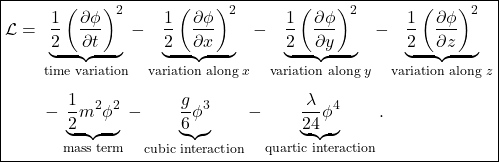
Therefore, all the terms written explicitly are
![Rendered by QuickLaTeX.com \[ \boxed{ \begin{aligned} \mathcal L={}& \underbrace{\frac12\left(\frac{\partial\phi}{\partial t}\right)^2}_{\text{time variation}} -\underbrace{\frac12\left(\frac{\partial\phi}{\partial x}\right)^2}_{\text{variation along }x} -\underbrace{\frac12\left(\frac{\partial\phi}{\partial y}\right)^2}_{\text{variation along }y} -\underbrace{\frac12\left(\frac{\partial\phi}{\partial z}\right)^2}_{\text{variation along }z} \\[4pt] &-\underbrace{\frac12m^2\phi^2}_{\text{mass term}} -\underbrace{\frac{g}{6}\phi^3}_{\text{cubic interaction}} -\underbrace{\frac{\lambda}{24}\phi^4}_{\text{quartic interaction}}. \end{aligned} } \]](https://stationarystates.com/wp-content/ql-cache/quicklatex.com-f62f38e0ad231996100b7da3a5754f31_l3.png)
Every field and derivative here is evaluated at the same spacetime point
.
2. What each group does
| Terms | Meaning |
|---|---|
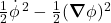
| Kinetic terms: describe how the field varies through spacetime | |
| Mass term: together with the kinetic terms, determines free propagation | |
| Self-interaction coupling three field factors at a vertex | |
| Self-interaction coupling four field factors at a vertex |
The factorials
and
are conventions that simplify the interaction vertex factors.
3. Free field versus interacting field
Setting
gives the free Klein–Gordon Lagrangian:

![]()
A common interacting example is
theory, with
:

![]()
This theory has the symmetry
, which forbids the cubic term.
The corresponding classical field equation shows how these terms enter the dynamics:

![Rendered by QuickLaTeX.com \[ \boxed{ \frac{\partial^2\phi}{\partial t^2} -\frac{\partial^2\phi}{\partial x^2} -\frac{\partial^2\phi}{\partial y^2} -\frac{\partial^2\phi}{\partial z^2} +m^2\phi +\frac{g}{2}\phi^2 +\frac{\lambda}{6}\phi^3 =0. } \]](https://stationarystates.com/wp-content/ql-cache/quicklatex.com-0f06eadadd12a37d8347be359233aa25_l3.png)
Leave a Reply