Time Dependence of Quantum Mechanical Operators
Time Dependence of Quantum Mechanical Operators
In quantum mechanics, the time dependence of operators depends on which representation (picture) we use — primarily the Schrödinger picture or the Heisenberg picture.
Both are equivalent, but they treat the time evolution of states and operators differently.
1. Schrödinger Picture
In the Schrödinger picture:
- The operators are typically time-independent (unless they explicitly depend on time, like a time-varying potential).
- The state vectors evolve with time according to the Schrödinger equation.
![\[ i\hbar \frac{\partial}{\partial t}|\psi_S(t)\rangle = \hat{H} |\psi_S(t)\rangle \]](https://stationarystates.com/wp-content/ql-cache/quicklatex.com-a5ae370929b511d5e23d13518b679fe7_l3.png "Rendered by QuickLaTeX.com")
If an operator itself depends explicitly on time (e.g., an external driving field), then its time dependence is just that explicit one.
![\[ \frac{d}{dt}\langle \hat{A} \rangle = \frac{1}{i\hbar}\langle [\hat{A},\hat{H}] \rangle + \left\langle \frac{\partial \hat{A}}{\partial t} \right\rangle \]](https://stationarystates.com/wp-content/ql-cache/quicklatex.com-8db2f5d4b4b410d18d40b28d261649f6_l3.png "Rendered by QuickLaTeX.com")
2. Heisenberg Picture
In the Heisenberg picture, the situation is reversed:
- The state vectors are constant in time (frozen at their initial value).
- The operators carry all the time dependence.
The operator evolution is given by the Heisenberg equation of motion:
![\[ \frac{d\hat{A}_H}{dt} = \frac{1}{i\hbar}[\hat{A}_H, \hat{H}] + \left(\frac{\partial \hat{A}_H}{\partial t}\right) \]](https://stationarystates.com/wp-content/ql-cache/quicklatex.com-1b2e0003cde204758d29266794b22b8e_l3.png "Rendered by QuickLaTeX.com")
The solution can also be expressed as a similarity transformation using the time-evolution operator 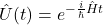 :
:
![\[ \hat{A}_H(t) = \hat{U}^\dagger(t)\,\hat{A}_S\,\hat{U}(t) \]](https://stationarystates.com/wp-content/ql-cache/quicklatex.com-c3964b6fa8e6190e3ad8a23196af267e_l3.png "Rendered by QuickLaTeX.com")
3. Examples
(a) Free Particle Momentum and Position
For a free particle with Hamiltonian  :
:
![\[ \frac{d\hat{p}_H}{dt} = \frac{1}{i\hbar}[\hat{p},\hat{H}] = 0 \quad \Rightarrow \quad \hat{p}_H(t) = \hat{p}(0) \]](https://stationarystates.com/wp-content/ql-cache/quicklatex.com-08d9fbda23caf8b4a5c59286aa061f7e_l3.png "Rendered by QuickLaTeX.com")
![\[ \frac{d\hat{x}_H}{dt} = \frac{1}{i\hbar}[\hat{x},\hat{H}] = \frac{\hat{p}}{m} \quad \Rightarrow \quad \hat{x}_H(t) = \hat{x}(0) + \frac{\hat{p}(0)}{m}t \]](https://stationarystates.com/wp-content/ql-cache/quicklatex.com-9eb35a11fe9fe000f90052dd14a893c9_l3.png "Rendered by QuickLaTeX.com")
This is a quantum analogue of classical motion with constant momentum and linearly increasing position.
(b) Harmonic Oscillator
For a 1D harmonic oscillator with  :
:
![\[ \frac{d\hat{x}_H}{dt} = \frac{\hat{p}_H}{m}, \quad \frac{d\hat{p}_H}{dt} = -m\omega^2 \hat{x}_H \]](https://stationarystates.com/wp-content/ql-cache/quicklatex.com-f491c32e249d120800211c3df9678d69_l3.png "Rendered by QuickLaTeX.com")
Combining gives:
![\[ \frac{d^2\hat{x}_H}{dt^2} + \omega^2 \hat{x}_H = 0 \]](https://stationarystates.com/wp-content/ql-cache/quicklatex.com-6e113ba8f41b17c6c4354e70a9154b00_l3.png "Rendered by QuickLaTeX.com")
Solution:
![\[ \hat{x}_H(t) = \hat{x}(0)\cos(\omega t) + \frac{\hat{p}(0)}{m\omega}\sin(\omega t) \]](https://stationarystates.com/wp-content/ql-cache/quicklatex.com-032230e41553bd816f198cbbbef89d31_l3.png "Rendered by QuickLaTeX.com")
![\[ \hat{p}_H(t) = \hat{p}(0)\cos(\omega t) - m\omega \hat{x}(0)\sin(\omega t) \]](https://stationarystates.com/wp-content/ql-cache/quicklatex.com-0d268cdc68bde5607892058fae66b8bc_l3.png "Rendered by QuickLaTeX.com")
This again mirrors classical oscillatory motion but with operator-valued amplitudes.
(c) Spin Precession in a Magnetic Field
For a spin- particle in a magnetic field
  , the Hamiltonian is
![\[ \hat{H} = -\gamma B \hat{S}_z \]](https://stationarystates.com/wp-content/ql-cache/quicklatex.com-34017d831e3b37e4493e708f99deeecb_l3.png "Rendered by QuickLaTeX.com")
Then:
![\[ \frac{d\hat{S}_x}{dt} = \frac{1}{i\hbar}[\hat{S}_x, \hat{H}] = \gamma B \hat{S}_y \]](https://stationarystates.com/wp-content/ql-cache/quicklatex.com-366457718dbeab12df8a650f909bc9cd_l3.png "Rendered by QuickLaTeX.com")
![\[ \frac{d\hat{S}_y}{dt} = -\gamma B \hat{S}_x \]](https://stationarystates.com/wp-content/ql-cache/quicklatex.com-704e634080efea7cf4464b8d271c13e5_l3.png "Rendered by QuickLaTeX.com")
So the spin components precess:
![\[ \hat{S}_x(t) = \hat{S}_x(0)\cos(\omega_L t) + \hat{S}_y(0)\sin(\omega_L t) \]](https://stationarystates.com/wp-content/ql-cache/quicklatex.com-ae9fa34c12093959490eb75fb697f9a8_l3.png "Rendered by QuickLaTeX.com")
![\[ \hat{S}_y(t) = \hat{S}_y(0)\cos(\omega_L t) - \hat{S}_x(0)\sin(\omega_L t) \]](https://stationarystates.com/wp-content/ql-cache/quicklatex.com-0e6b098ecfd46b841d062f069ff618ef_l3.png "Rendered by QuickLaTeX.com")
where  is the Larmor frequency.
4. Summary
| Picture | State | Operator | Equation of Motion |
|---|---|---|---|
| Schrödinger |  |
Usually time-independent | ![\frac{d}{dt}\langle \hat{A} \rangle = \frac{1}{i\hbar}\langle [\hat{A},\hat{H}] \rangle + \langle \partial_t \hat{A} \rangle](https://stationarystates.com/wp-content/ql-cache/quicklatex.com-ab9bd6f7b7efa0b2b92e1fd654f24320_l3.png "Rendered by QuickLaTeX.com") |
| Heisenberg | Time-independent |  |
![\frac{d\hat{A}_H}{dt}=\frac{1}{i\hbar}[\hat{A}_H,\hat{H}] + \partial_t \hat{A}_H](https://stationarystates.com/wp-content/ql-cache/quicklatex.com-7517e0269a17bd35eaa75a3b3229fd67_l3.png "Rendered by QuickLaTeX.com") |
Thus, in quantum mechanics, operators evolve in time via commutators with the Hamiltonian, reflecting the deep correspondence between quantum and classical dynamics (where ![[A,H]/(i\hbar)](https://stationarystates.com/wp-content/ql-cache/quicklatex.com-4b25a61a91ef512798efb66dd9dce140_l3.png "Rendered by QuickLaTeX.com") parallels the classical Poisson bracket
parallels the classical Poisson bracket  ).
).