Choosing the Axis to Measure Spin
Spin-½ measurement along a rotated axis (Pauli-matrix derivation)
We will show explicitly—using Pauli matrices—why a spin-½ measurement along any direction still yields exactly two outcomes, and compute the probabilities when the measurement axis is rotated by  from the original
  -axis.
1) Pauli matrices and spin operators
![\[ \sigma_x = \begin{pmatrix} 0 & 1 \\[4pt] 1 & 0 \end{pmatrix},\quad \sigma_y = \begin{pmatrix} 0 & -i \\[4pt] i & 0 \end{pmatrix},\quad \sigma_z = \begin{pmatrix} 1 & 0 \\[4pt] 0 & -1 \end{pmatrix}. \]](https://stationarystates.com/wp-content/ql-cache/quicklatex.com-a7a44e48f7ea6b4e0b0b6b68a6605db9_l3.png "Rendered by QuickLaTeX.com")
The spin operator along a unit direction  is
is
![\[ \hat S_{\hat n} \;=\; \frac{\hbar}{2}\,(\vec\sigma\!\cdot\!\hat n)\,, \quad \text{with}\quad \vec\sigma\!\cdot\!\hat n \;=\; n_x \sigma_x + n_y \sigma_y + n_z \sigma_z. \]](https://stationarystates.com/wp-content/ql-cache/quicklatex.com-327a0fdf49e00b2a90500eed8a11138d_l3.png "Rendered by QuickLaTeX.com")
For any direction , the eigenvalues of  are always
  . Thus there are always two outcomes, independent of the axis.
2) Choose a new axis rotated by from the -axis
Let the original measurement axis be  . Rotate the apparatus by an angle
  toward
  about the
  -axis. The new unit vector is
![\[ \hat n' \;=\; (\cos\theta,\,0,\,\sin\theta). \]](https://stationarystates.com/wp-content/ql-cache/quicklatex.com-86f01d8dcfa9e977fc9bb272b39ade2e_l3.png "Rendered by QuickLaTeX.com")
Then
![\[ \vec\sigma\!\cdot\!\hat n' \;=\; \cos\theta\,\sigma_x \;+\; \sin\theta\,\sigma_z \;=\; \begin{pmatrix} \sin\theta & \cos\theta \\[4pt] \cos\theta & -\sin\theta \end{pmatrix}. \]](https://stationarystates.com/wp-content/ql-cache/quicklatex.com-8cc0ae6d513af189653464bca4f33026_l3.png "Rendered by QuickLaTeX.com")
For with  and
and  ,
,
![\[ \vec\sigma\!\cdot\!\hat n' \;=\; \begin{pmatrix} \frac{1}{2} & \frac{\sqrt{3}}{2} \\[6pt] \frac{\sqrt{3}}{2} & -\frac{1}{2} \end{pmatrix}, \qquad \hat S_{\hat n'} \;=\; \frac{\hbar}{2}\,\vec\sigma\!\cdot\!\hat n'. \]](https://stationarystates.com/wp-content/ql-cache/quicklatex.com-5d5b2c35eaf1241f7112e37fc871960b_l3.png "Rendered by QuickLaTeX.com")
3) Eigenvalues (two outcomes only) and eigenvectors
The characteristic equation of  is
is
![\[ \det\big(\vec\sigma\!\cdot\!\hat n' - \lambda I\big) = \lambda^2 - 1 = 0 \;\;\Rightarrow\;\; \lambda=\pm 1. \]](https://stationarystates.com/wp-content/ql-cache/quicklatex.com-7fedbf81394a33a50c9c511c99a4ebec_l3.png "Rendered by QuickLaTeX.com")
Therefore the measurement outcomes for  are always .
A corresponding  eigenvector (for general
  ) can be taken as
![\[ |+\hat n'\rangle \;=\; \begin{pmatrix}\cos\frac{\theta}{2}\\[4pt]\sin\frac{\theta}{2}\end{pmatrix} \quad\text{and}\quad |-\hat n'\rangle \;=\; \begin{pmatrix}-\sin\frac{\theta}{2}\\[4pt]\cos\frac{\theta}{2}\end{pmatrix}, \]](https://stationarystates.com/wp-content/ql-cache/quicklatex.com-047000c81d02aa9d379433b54dfa9cc1_l3.png "Rendered by QuickLaTeX.com")
when we work in the  (i.e.,
  ) basis and choose azimuth
  (the
(the  plane).
4) Start in  and measure along the rotated axis
In the basis, the  eigenstates are
![\[ |+\!x\rangle \;=\; \frac{1}{\sqrt{2}} \begin{pmatrix}1\\[2pt]1\end{pmatrix}, \qquad |-\!x\rangle \;=\; \frac{1}{\sqrt{2}} \begin{pmatrix}1\\[2pt]-1\end{pmatrix}. \]](https://stationarystates.com/wp-content/ql-cache/quicklatex.com-0a884a2bf1378e191b1c9c14e431321c_l3.png "Rendered by QuickLaTeX.com")
If the system is prepared in and we measure , the probability of obtaining  is
is
![\[ P_{+}(\hat n' \mid +x) \;=\; \big|\langle +\hat n' \,|\, +x \rangle\big|^2 \;=\; \cos^2\!\frac{\theta}{2}, \]](https://stationarystates.com/wp-content/ql-cache/quicklatex.com-4720627aed82de0e18f10f3ef51db843_l3.png "Rendered by QuickLaTeX.com")
and  . This can be derived either by the explicit overlap of the spinors above, or by the Bloch-vector identity
![\[ P_{+}(\hat n' \mid \hat a) \;=\; \frac{1+\hat a\!\cdot\!\hat n'}{2}, \quad\text{with}\;\; \hat a=\hat x \;\Rightarrow\; P_{+}=\frac{1+\cos\theta}{2}=\cos^2\!\frac{\theta}{2}. \]](https://stationarystates.com/wp-content/ql-cache/quicklatex.com-c67b7b69534af16ef3ba0fb8c5a98910_l3.png "Rendered by QuickLaTeX.com")
5) Plug in
![\[ \cos\frac{\theta}{2}=\cos 15^\circ =\sqrt{\frac{1+\cos30^\circ}{2}} =\sqrt{\frac{1+\tfrac{\sqrt{3}}{2}}{2}} =\sqrt{\frac{2+\sqrt{3}}{4}} \quad\Rightarrow\quad \cos^2 15^\circ=\frac{2+\sqrt{3}}{4}\approx 0.933. \]](https://stationarystates.com/wp-content/ql-cache/quicklatex.com-f09b5ecba7fc764d413992eda3819cca_l3.png "Rendered by QuickLaTeX.com")
![\[ \sin^2 15^\circ=\frac{2-\sqrt{3}}{4}\approx 0.067. \]](https://stationarystates.com/wp-content/ql-cache/quicklatex.com-d9cb277326fe60d07df430c9bbdcdebe_l3.png "Rendered by QuickLaTeX.com")
Therefore, for a rotation of the measurement axis relative to , a state prepared as yields
- Outcome along with probability
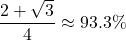 .
. - Outcome
 along with probability
 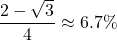 .
.
6) What is special about the chosen direction?
Physically, no direction is special: quantum spin for a spin-½ particle always has two eigenvalues along any axis. What is special is that the experimentalist’s chosen direction defines the observable:
![\[ \hat S_{\hat n} \;=\; \frac{\hbar}{2}\,(\vec\sigma\!\cdot\!\hat n), \]](https://stationarystates.com/wp-content/ql-cache/quicklatex.com-2223fd33efcba323d0ddcaeb886108f2_l3.png "Rendered by QuickLaTeX.com")
and distinct directions correspond to non-commuting operators (e.g. ![[\hat S_x,\hat S_z]\neq 0](https://stationarystates.com/wp-content/ql-cache/quicklatex.com-db0dc489cc26b129fd212a608f5c7c7c_l3.png "Rendered by QuickLaTeX.com") ). Changing the apparatus orientation rotates the measurement basis; it does not change the two-valued spectrum.
). Changing the apparatus orientation rotates the measurement basis; it does not change the two-valued spectrum.
7) One-line summary
Rotate the experiment by any angle you like (e.g. ): the spin-½ measurement still has outcomes  ; only the probabilities change according to
  and
and  .
.