Electron Wavefunction After Photon Collision
Electron Wavefunction After a Photon–Electron Collision
Setup
Initial (asymptotic “in”) state:
- Photon plane wave

- Electron wavepacket
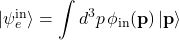
The scattering operator  produces the entangled “out” state:
![\[ \lvert \Psi_{\mathrm{out}} \rangle = \sum_{\varepsilon'} \int d^3k'\, d^3p'\; \mathcal{M}_{\varepsilon'\varepsilon}\!\big(\mathbf{p},\mathbf{k} \to \mathbf{p}',\mathbf{k}'\big)\, \phi_{\mathrm{in}}(\mathbf{p})\; \lvert \gamma:\mathbf{k}',\varepsilon' \rangle \otimes \lvert \mathbf{p}' \rangle, \]](https://stationarystates.com/wp-content/ql-cache/quicklatex.com-7a9f34159832699b62de87c64886b095_l3.png "Rendered by QuickLaTeX.com")
Energy–momentum conservation is built into the matrix element  .
.
Electron State Conditioned on Detecting the Outgoing Photon 
Project onto  and renormalize. Let the momentum transfer be
  . Then the electron’s conditional momentum-space wavefunction is
![\[ \boxed{ \phi_{\mathrm{out}}^{(\mathbf{k}',\varepsilon')}(\mathbf{p}') \;\propto\; \mathcal{M}_{\varepsilon'\varepsilon}\!\big(\mathbf{p}'-\mathbf{q},\mathbf{k}\to \mathbf{p}',\mathbf{k}'\big)\; \phi_{\mathrm{in}}(\mathbf{p}'-\mathbf{q}) } \]](https://stationarystates.com/wp-content/ql-cache/quicklatex.com-624ef0beb9537a6bad2259145d516025_l3.png "Rendered by QuickLaTeX.com")
Intuition: the packet is shifted by the recoil  , weighted by the Compton/Thomson matrix element.
Position-Space Picture
![\[ \boxed{ \psi_{\mathrm{out}}^{(\mathbf{k}',\varepsilon')}(\mathbf{r}) \;\propto\; \Big[\mathcal{A}_{\varepsilon'\varepsilon}(\hat{\mathbf{k}} \to \hat{\mathbf{k}}',\,\mathbf{p})\Big]\; e^{\,i\,\mathbf{q}\cdot \mathbf{r}}\; \psi_{\mathrm{in}}(\mathbf{r}) } \]](https://stationarystates.com/wp-content/ql-cache/quicklatex.com-4cfd773897ed03d2f2d211dcd766ae1d_l3.png "Rendered by QuickLaTeX.com")
That is, the electron wavefunction acquires a plane-wave phase factor  (a momentum kick) times an angular/polarization-dependent scattering amplitude
  .
.
Useful Limits
Thomson (Low-Energy) Limit: 
Here is nearly momentum-independent and  with the classical electron radius
  . Then
![\[ \phi_{\mathrm{out}}(\mathbf{p}') \propto \phi_{\mathrm{in}}(\mathbf{p}' - \mathbf{q}), \qquad \psi_{\mathrm{out}}(\mathbf{r}) \propto e^{i\mathbf{q}\cdot \mathbf{r}} \,\psi_{\mathrm{in}}(\mathbf{r}). \]](https://stationarystates.com/wp-content/ql-cache/quicklatex.com-6c7feeb587d73c9ab585f050e373c5a3_l3.png "Rendered by QuickLaTeX.com")
Compton Regime (Relativistic Photon Kinematics)
The detected photon energy fixes the recoil via the Compton formula
![\[ \lambda' - \lambda = \lambda_C (1 - \cos\theta), \qquad \lambda_C = \frac{h}{m_e c}, \]](https://stationarystates.com/wp-content/ql-cache/quicklatex.com-e692f64f824936ce6927c9db82836d2b_l3.png "Rendered by QuickLaTeX.com")
and reduces to the Klein–Nishina amplitude, delivering the usual angular/polarization factors. The momentum-shift expression above still holds, with supplying the correct relativistic weights.
If You Do Not Detect the Photon
You must trace out the photon degrees of freedom:
![\[ \rho_e^{\mathrm{out}} = \mathrm{Tr}_{\gamma}\!\big[\, \lvert \Psi_{\mathrm{out}} \rangle \langle \Psi_{\mathrm{out}} \rvert \, \big] = \sum_{\varepsilon'} \int d^3k'\; \lvert \psi_e^{(\mathbf{k}',\varepsilon')} \rangle \langle \psi_e^{(\mathbf{k}',\varepsilon')} \rvert, \]](https://stationarystates.com/wp-content/ql-cache/quicklatex.com-4de7583f7240dcb63ab0611525c9c07f_l3.png "Rendered by QuickLaTeX.com")
which is generally a mixed state—not representable by a single wavefunction.
Takeaway
- The collision creates entanglement between the photon and electron.
- Conditioned on a specific scattered photon
 , the electron’s wavefunction is its initial packet shifted by the recoil
  and weighted by the appropriate scattering amplitude.
 - Unconditioned, the electron is in a mixed state, so a density matrix is required.