Angular momentum for particle in a box
https://stationarystates.com/basic-quantum-theory/angular-momentum…article-in-a-box/
Energy Levels of a Particle in a Box with Angular Momentum
1. Particle in a 1D Box
In 1D, angular momentum doesn’t exist in the usual sense because rotation requires at least two dimensions.
Energy levels remain:
![\[ E_n = \frac{n^2 \pi^2 \hbar^2}{2 m L^2}, \quad n = 1,2,3,\dots \]](https://stationarystates.com/wp-content/ql-cache/quicklatex.com-795a06dffb7bee0914168903a5ff3fb6_l3.png "Rendered by QuickLaTeX.com")
2. Particle in a 2D or 3D Box
For a 2D rectangle or 3D cube, the Schrödinger equation separates in Cartesian coordinates:
![\[ \psi(x,y,z) = X(x) Y(y) Z(z) \]](https://stationarystates.com/wp-content/ql-cache/quicklatex.com-fe2fa62c99b6c94336c3e999a987d3ea_l3.png "Rendered by QuickLaTeX.com")
Angular momentum is not conserved in a cubical box. Energy depends on quantum numbers along each axis:
![\[ E_{n_x,n_y,n_z} = \frac{\hbar^2 \pi^2}{2 m} \left( \frac{n_x^2}{L_x^2} + \frac{n_y^2}{L_y^2} + \frac{n_z^2}{L_z^2} \right) \]](https://stationarystates.com/wp-content/ql-cache/quicklatex.com-4c961439ce6609a6cf0bd7b76e4c58b6_l3.png "Rendered by QuickLaTeX.com")
3. Particle in a Spherical Box
If the box is spherically symmetric, angular momentum L is a good quantum number.
The Schrödinger equation in spherical coordinates:
![\[ -\frac{\hbar^2}{2m} \nabla^2 \psi(r,\theta,\phi) = E \psi(r,\theta,\phi) \]](https://stationarystates.com/wp-content/ql-cache/quicklatex.com-b7bad632d9dcbd9d1323b414a5667f8d_l3.png "Rendered by QuickLaTeX.com")
Separate variables:
![\[ \psi(r,\theta,\phi) = R_{n\ell}(r) Y_\ell^m(\theta,\phi) \]](https://stationarystates.com/wp-content/ql-cache/quicklatex.com-b142c9dc1e3eaaad400288145a2f3ae3_l3.png "Rendered by QuickLaTeX.com")
where Y_\ell^m are spherical harmonics and \ell is the angular momentum quantum number.
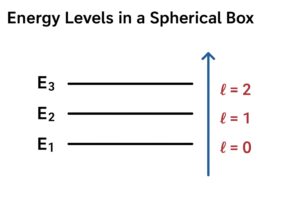
Energy levels include a centrifugal term:
![\[ E_{n\ell} = \frac{\hbar^2}{2m} \left( \frac{\alpha_{n\ell}}{R} \right)^2 \]](https://stationarystates.com/wp-content/ql-cache/quicklatex.com-78519de34252a8c78343e593d6c7163e_l3.png "Rendered by QuickLaTeX.com")
Here,  are the zeros of spherical Bessel functions.
Larger angular momentum ( ) increases energy because the wavefunction is “pushed outward”.
4. Key Takeaways
- 1D box: Angular momentum is irrelevant; energy levels are unchanged.
- Rectangular/cubical box: Energy depends on quantum numbers along each axis, not angular momentum.
- Spherical box: Higher angular momentum quantum number
\ellraises the energy.
Intuition: Higher angular momentum → particle “rotates” more → less probability near the center → higher energy.