Tidal Forces inside a black hole
Tidal Forces for a 100 kg Human Falling into Black Holes
We quantify tidal accelerations for a 100 kg person of length  falling feet-first toward two black holes:
a stellar-mass black hole with  and a supermassive black hole (SMBH) with
  .
.
Outside the horizon of a non-rotating (Schwarzschild) black hole, the dominant components agree with the Newtonian tidal tensor and scale as  .
.
Radial stretching (head vs. feet):
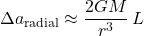
Transverse squeezing (side-to-side):
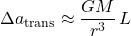
Schwarzschild radius (event horizon):

A. Tidal Forces at the Event Horizon
Evaluating the radial gradient at  gives the compact scaling
![\[ \Delta a_{\rm horizon} \;=\; \frac{c^{6}\,L}{4\,G^{2}\,M^{2}} \;\propto\; M^{-2}. \]](https://stationarystates.com/wp-content/ql-cache/quicklatex.com-ae979a315c11a2f64989cae5b879f183_l3.png "Rendered by QuickLaTeX.com")
| Black hole |  (m/s (m/s ) ) |
As multiples of  |
Force on 100 kg  |
|---|---|---|---|
Stellar,  |
 |
 |
 |
SMBH,  |
 |
 |
 |
Takeaway: Tidal gradients at the horizon fall as  . For stellar-mass BHs they are enormous; for SMBHs they are tiny at horizon crossing.
B. Where Do Tidal Forces Reach Human-Noticeable Levels?
Set a target gradient  and solve for the radius at which the radial component reaches this value:
![\[ r(a_{\!*}) \;=\; \Bigg(\frac{2GM\,L}{a_{\!*}}\Bigg)^{1/3}. \]](https://stationarystates.com/wp-content/ql-cache/quicklatex.com-e431c979f37f2a80fcf83c9979e675f8_l3.png "Rendered by QuickLaTeX.com")
Compare to  to see if this occurs outside or inside the horizon.
Chosen thresholds
- Mild discomfort:

- Severe:

- Extreme:

(1) Stellar BH: , 
 :
:  (outside)
 :
: 
 :
: 
Implication: A human is torn apart well before reaching the horizon of a stellar-mass BH.
(2) SMBH: , 
- :
 (inside)
 - :
 (inside)
 - :
 (deep inside)
Implication: You cross a SMBH horizon with negligible tidal sensation; damaging gradients arise only well inside.
C. Values at Fixed Multiples of the Horizon Radius
Because  , the gradient grows extremely rapidly as you approach the center.
| Case | Radius |  (m/s) (m/s) |
As multiples of |
|---|---|---|---|
Stellar  |
 |
 |
 |
| Stellar |
 |
 |
 |
SMBH  |
|
 |
 |
D. Geodesic Deviation (Curvature View)
The tidal accelerations are encoded by geodesic deviation:
![\[ \frac{D^2 \xi^\mu}{d\tau^2} \;=\; -\, R^\mu_{\ \nu\rho\sigma}\, u^\nu\, \xi^\rho\, u^\sigma, \]](https://stationarystates.com/wp-content/ql-cache/quicklatex.com-c9b205562cd079a0fb5e4154bf870459_l3.png "Rendered by QuickLaTeX.com")
where  is the separation vector between neighboring points on the body,
  the 4-velocity, and
  the Riemann curvature tensor. In Schwarzschild spacetime, the principal components reduce to the gradients used above outside the horizon.
Bottom Line
- Stellar BH (~): lethal tidal gradients occur far outside the horizon.
- Supermassive BH (~
 –
– ): horizon crossing is uneventful; destructive tides arise only well inside.
Want a quick variant with a different body length (e.g.,  ) or a different SMBH mass (e.g.,
  )? The same formulas apply; only the numbers change via the
  and
and  scalings.